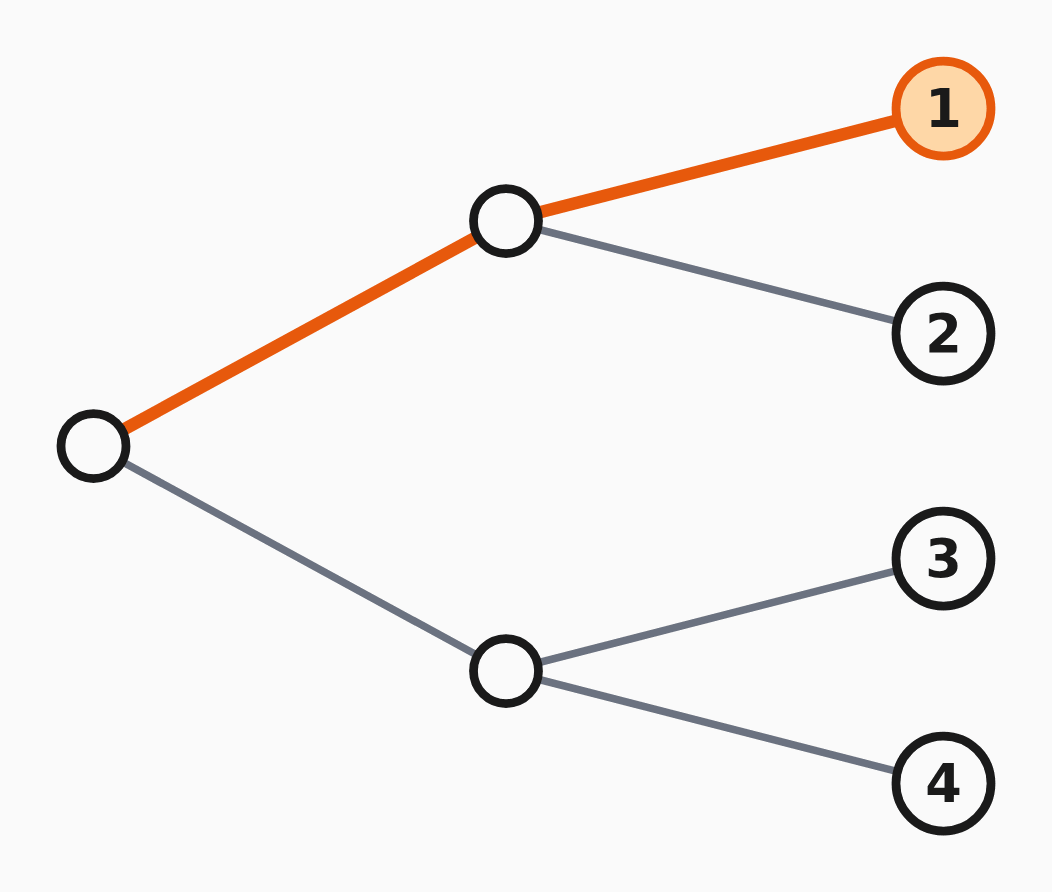
A tree diagram helps whenever you have two (or more) independent choices and want to count all combinations together.
Example — a T-shirt
Sara is buying a T-shirt. The shop offers three colours (red, blue, green) and two sizes (M, L). How many different T-shirts can she pick?
The tree has two levels. The first level branches into colours, the second into sizes:
- red → M, L
- blue → M, L
- green → M, L
Together 3 · 2 = 6 options.
The rule
If the first choice has p options and the second has r options, the total number of combinations is p · r. The tree has exactly that many leaves.
Example — pizza
A pizzeria has 2 doughs and 4 toppings. The number of pizzas is 2 · 4 = 8.
Choosing pairs — order does not matter
For pairs (for example, "pick two friends to help out") order does not matter — the pair "Adam and Brian" is the same as "Brian and Adam".
For n items, the number of pairs is:
- n = 3: pairs are 1-2, 1-3, 2-3 — that is 3.
- n = 4: pairs are 1-2, 1-3, 1-4, 2-3, 2-4, 3-4 — that is 6.
- n = 5: there are 10 pairs.
A quick-check formula: number of pairs = n · (n − 1) / 2.
Why divide by two?
If we counted order, we would have n · (n − 1) ordered pairs. But "A, B" and "B, A" are the same pair — so we divide by two.
Things to watch out for
- For two independent choices, multiply.
- For one group out of which you pick a pair, divide by two.
- A tree diagram is your best friend in the first situation.