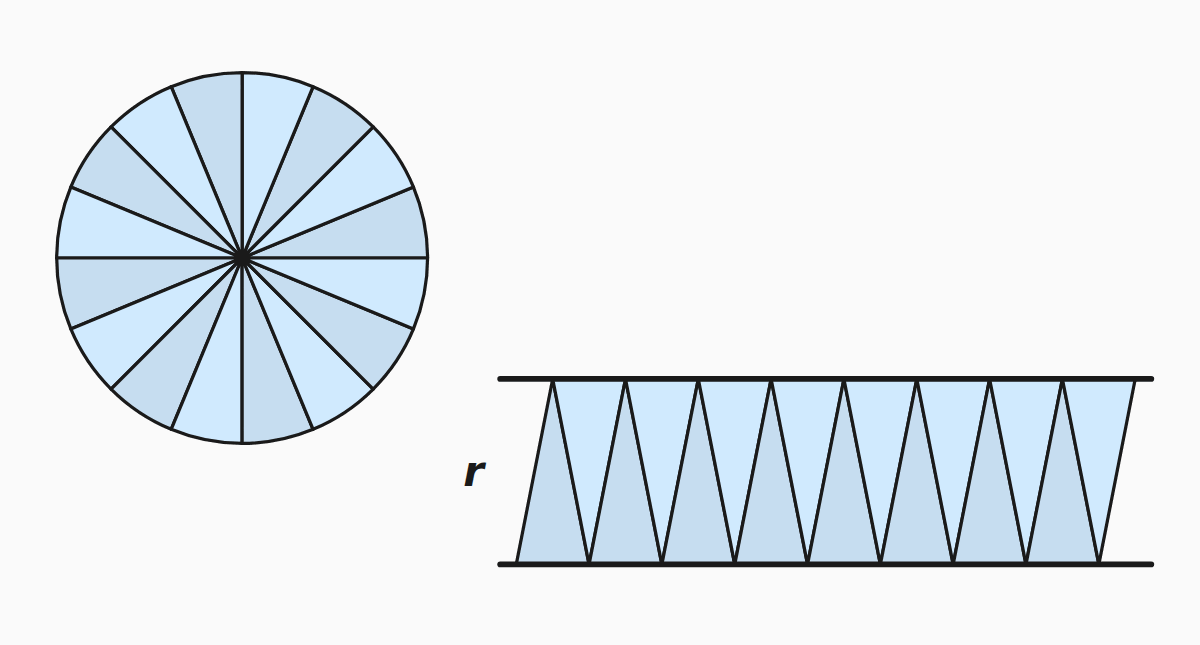
The area of a circle is how much surface the circle covers. We measure it in square units — square centimetres for small circles, square metres for ponds and pools, square kilometres for huge round patches on a map. The formula for the area of a circle is
S = π · r².
We use π ≈ 3.14 and the radius r is the distance from the centre to the edge.
A small example
A round table has a radius of r = 0.5 m. Its area is
S ≈ 3.14 · 0.5 · 0.5 = 0.785 ≈ 0.8 m².
That is roughly the size of a placemat for one person — which makes sense for a small round table.
Why the unit is squared
The radius is a length, measured in metres or centimetres. When we compute r · r we multiply two lengths together, which gives an area — so the unit is m² or cm². If you forget the little 2 in the unit, the answer looks like a length, and a length cannot be an area.
Comparing two circles
If you double the radius, what happens to the area? Try r = 2 cm and r = 4 cm:
- r = 2 → S ≈ 3.14 · 4 = 12.6 cm².
- r = 4 → S ≈ 3.14 · 16 = 50.2 cm².
Doubling the radius makes the area four times bigger, not two times. That is because r² grows much faster than r.
A common mistake
A frequent error is to write S = 2 · π · r (that is the circumference, a length) or to forget to square the radius. To stay safe, say to yourself: "pi times r times r" before you start.