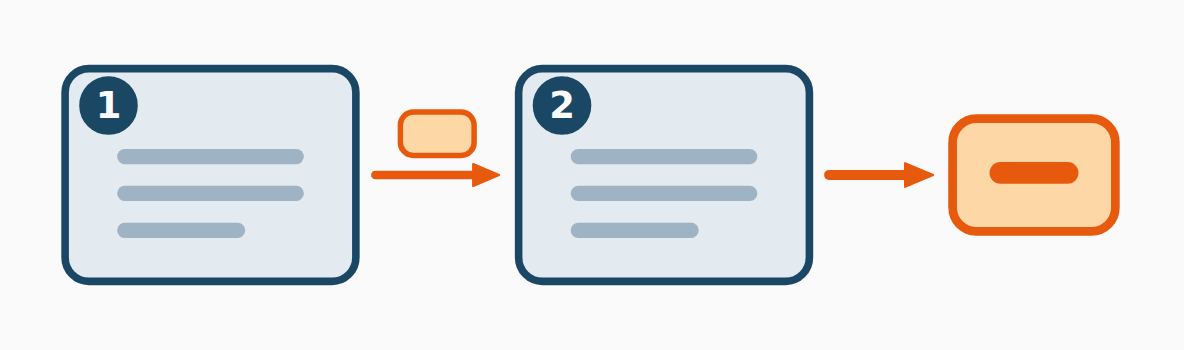
Multi-step problems become common in Year 6. They look hard because they have a lot of data and several sentences. The trick is simple: split the problem into smaller steps and work each step on its own.
A method that works every time
- Read the problem twice.
- Underline the data and the question.
- Plan — what's the intermediate result of step 1, what of step 2?
- Compute each step on its own.
- Combine the results.
- Sanity-check with an estimate.
Example: savings and spending
Problem. Mia saves £8 every week. After 6 weeks she spends £12. How much does she have left? Plan:- Step 1: Total saved? `8 × 6 = £48.`
- Step 2: Left over? `48 − 12 = £36.`
Answer: £36.
Example: two purchases
Problem. The class bought 4 packs of 10 notebooks and 5 packs of 6 pens. How many items in total? Plan:- Notebooks: `4 × 10 = 40`.
- Pens: `5 × 6 = 30`.
- Total: `40 + 30 = 70`.
Example: groups of people, books
Problem. A club has 8 boys and 5 girls. Each buys 3 books. How many books in total? Plan:- Total people: `8 + 5 = 13`.
- Books: `13 × 3 = 39`.
Try the alternative: boys `8 × 3 = 24` + girls `5 × 3 = 15` = 39. Same answer via the distributive property.
Tips
- Write the intermediate result in the margin so you don't forget it.
- Check units after each step (pounds, grams, items).
- Estimate to spot order-of-magnitude errors. If you get 360 and it should be near 36, something is off.
Common traps
- Adding when you should multiply (or vice versa). "X times Y" → multiply; "X and Y together" → add.
- Forgetting a step. After each step, check if the problem requires another step.
- Carrying a wrong intermediate result. If step 1 is wrong, step 2 inherits the mistake.