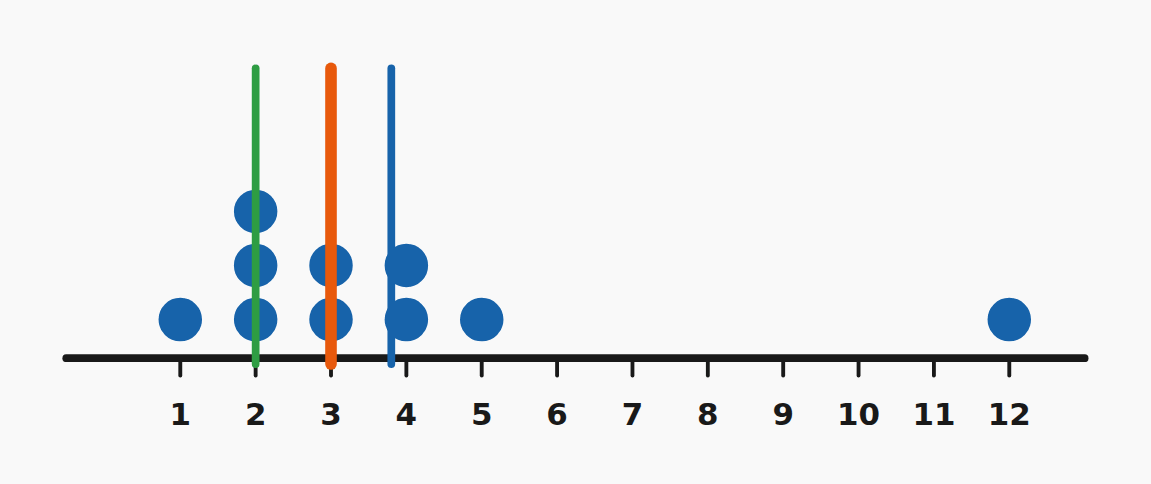
In Year 6 you've met three different "averages": mean, median and mode. Each one is right for a different kind of question. Here's a quick guide to picking the right one.
Quick decision
| Use this | When the data is… |
| Mean | Roughly symmetric, no outliers |
| Median | Skewed or has outliers |
| Mode | Categorical, or you want the most common value |
Mean — the "fair share"
The mean tells you what each item would be if you shared the total equally.
When to use it. Class quiz scores: 6, 7, 7, 8, 9 → mean = 7.4. A reasonable typical score. When to avoid. Salaries in a small company where one person earns ten times more than the rest — the mean is pulled up by the outlier.Mean = sum ÷ count.
Median — the "middle one"
Sort the values and pick the middle one (or the average of the two middle ones).
When to use it. Skewed data. House prices: 200k, 220k, 230k, 250k, 1.5 million → median = 230k, which describes "a typical house" much better than the mean.Median = the value at the centre of the sorted list.
Mode — the "most popular"
The value that appears most often.
When to use it. Categories. "Which colour is most popular?" — only the mode makes sense (the mean of "red, blue, green" is meaningless).Mode = the most frequent value.
Examples
Test results 5, 6, 6, 7, 8.- Mean = 6.4. Median = 6. Mode = 6. All similar — symmetric data.
- Mean = 22. Median = 3. Use the median — the 100 is an outlier.
- Mode = 39 (most common). For shoe shop stocking decisions, the mode is what you want.