There are 28 students in a class. 9 of them sing in the school choir. Every choir member is also a student in the class — the choir is part of the class. In maths we say that the set of choir members is a subset of the set of students in the class.
A set A is a subset of a set B if every element of A also belongs to B. We write:
A ⊆ B — read “A is a subset of B”.
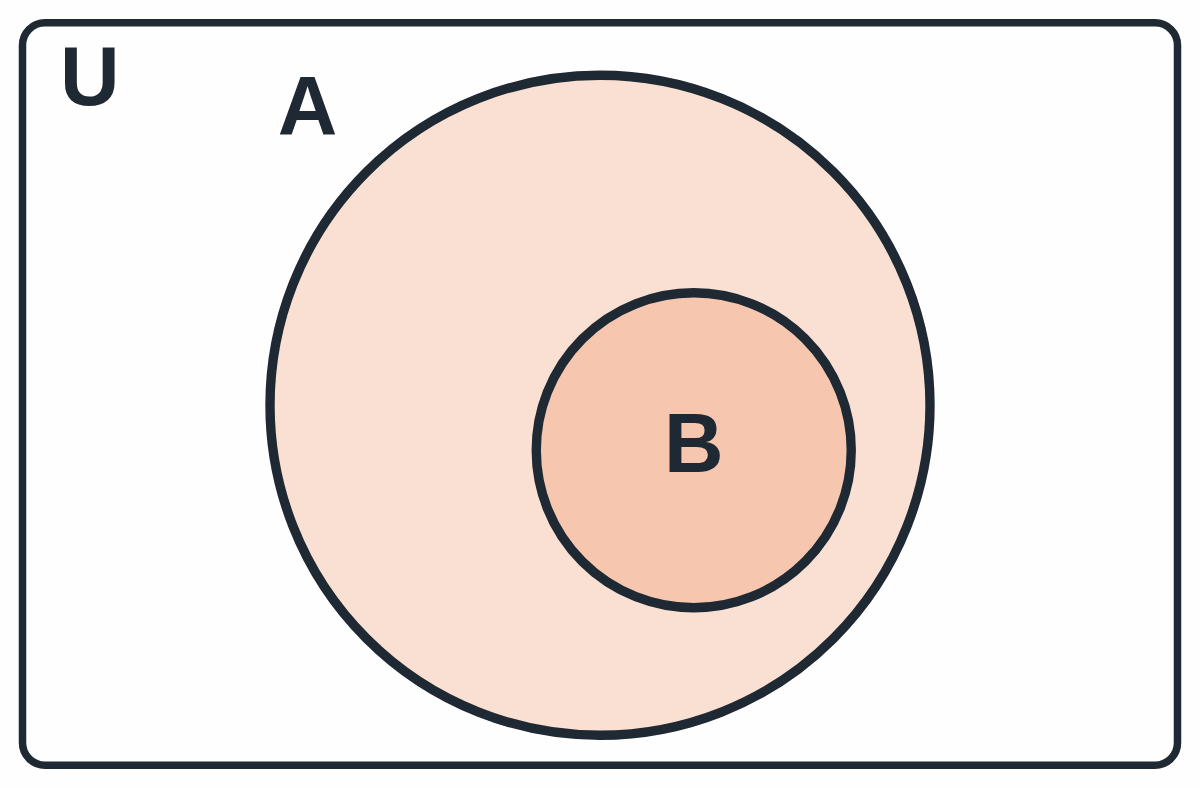
In the picture, circle B lies completely inside circle A, so B ⊆ A. There is nothing in B that is not also in A.
Examples:
{2, 4} ⊆ {1, 2, 3, 4} — both 2 and 4 are in the bigger set,
ℕ ⊆ ℤ — every natural number is an integer,
{1, 5} ⊈ {1, 2, 3} — the number 5 is not in the bigger set. The symbol ⊈ means “is not a subset of”.
💡 Some books write ⊂ instead of ⊆. Others use ⊂ only for a proper subset — a subset that is smaller than the whole set. Check which one your book uses.
Two interesting rules:
Every set is a subset of itself: A ⊆ A.
The empty set is a subset of every set: ∅ ⊆ A. It has no element that could be “missing”.
How to check whether A ⊆ B
Go through the elements of A one by one and ask each time: “Is it also in B?”
If yes for all of them → A ⊆ B.
If you find even one element of A that is not in B → A ⊈ B.
Worked example 1
Is A = {3, 6, 9} a subset of B = {x ∈ ℕ | x is a factor of 18}?
List B: the factors of 18 are 1, 2, 3, 6, 9, 18. B = {1, 2, 3, 6, 9, 18}.
3 ∈ B ✓, 6 ∈ B ✓, 9 ∈ B ✓.
Yes, A ⊆ B.
Equal sets
Two sets are equal (A = B) if they have exactly the same elements. In other words: A ⊆ B and also B ⊆ A.
The order and the way they are written do not matter:
{1, 2, 3} = {3, 1, 2},
{x ∈ ℤ | x² = 4} = {−2, 2},
{x ∈ ℕ | x is an even prime number} = {2}.
💡 Check equality in two steps. First check that every element of A is in B, then that every element of B is in A.
When neither set is a subset of the other
Very often neither A ⊆ B nor B ⊆ A. For example A = {1, 2, 3} and B = {2, 3, 4}:
1 is in A but not in B → A ⊈ B,
4 is in B but not in A → B ⊈ A.
The sets have elements in common (2 and 3), but each one also has something of its own.
Sets given by a rule
If a set is given by a rule, list its elements first. Only then compare.
Worked example 2
Compare A = {x ∈ ℤ | |x| ≤ 2} and B = {x ∈ ℤ | −2 ≤ x < 3}.
A: integers at most 2 away from zero. A = {−2, −1, 0, 1, 2}.
B: integers from −2 (included) up to 3 (not included). B = {−2, −1, 0, 1, 2}.
Both have exactly the same elements. A = B.
Worked example 3
Compare A = {x ∈ ℕ | x is a factor of 6} and B = {x ∈ ℕ | x is a factor of 12}.
A = {1, 2, 3, 6}, B = {1, 2, 3, 4, 6, 12}.
Every element of A is in B → A ⊆ B.
The number 4 is in B but not in A → A ≠ B.
A ⊆ B and A ≠ B. (Every factor of 6 is also a factor of 12, because 6 divides 12.)
Common mistakes
The direction of the subset: A ⊆ B says that A is smaller or the same. It means “A is inside B”, not the other way round.
A few common elements are not enough: it is not enough that A and B share something. Every element of A must be in B.
Order of elements: {1, 2, 3} and {3, 2, 1} are the same set.
Forgetting the empty set: ∅ ⊆ A is true for every set A.
Summary
A ⊆ B: every element of A is also in B.
A = B: A ⊆ B and also B ⊆ A. Same elements, order does not matter.
A ⊆ A and ∅ ⊆ A are always true.
List sets given by a rule first, then compare them.
Try it yourself
Is {2, 5} ⊆ {1, 2, 3, 4, 5}?
Is {−1, 1} ⊆ ℕ?
Compare A = {x ∈ ℤ | x² = 16} and B = {−4, 4}.
Compare A = {x ∈ ℕ | x is a prime number, x < 10} and B = {x ∈ ℕ | x is odd, x < 10}.
Write down all the subsets of the set {a, b}.
Answers
Yes, both 2 and 5 are in the bigger set.
No, −1 ∉ ℕ.
A = {−4, 4}, so A = B.
A = {2, 3, 5, 7}, B = {1, 3, 5, 7, 9}. 2 ∈ A but 2 ∉ B. And 1 ∈ B but 1 ∉ A. Neither set is a subset of the other.
∅, {a}, {b}, {a, b} — four subsets. Do not forget the empty set and the set itself.