
A small child counting toy cars only needs 1, 2, 3, … When we read a thermometer in winter, we also need −5 °C. When we cut a pizza into three pieces, we get 1/3. And when we measure the diagonal of a square with side 1 m, we get √2 m — a number that cannot be written as a fraction at all.
Mathematicians “added” new numbers exactly like this, whenever they needed them. That is how we got five number sets that fit inside each other like boxes inside boxes.
Contents
- Natural numbers ℕ
- Integers ℤ
- Rational numbers ℚ
- Irrational numbers
- Real numbers ℝ
- How they fit together
- How to decide where a number belongs
- Common mistakes
- Summary
- Try it yourself
- Answers
- Practise
Natural numbers ℕ
ℕ = {1, 2, 3, 4, …} — the numbers we count things with.⚠️ Books do not agree about zero. Some include 0 in ℕ, others do not. In this article ℕ = {1, 2, 3, …}, and if we want zero too, we write ℕ₀ = {0, 1, 2, 3, …}. Check how your textbook does it.
In ℕ we can always add and multiply. But we cannot always subtract: 3 − 5 = −2, and that is not a natural number.
Integers ℤ
ℤ = {…, −3, −2, −1, 0, 1, 2, 3, …} — the natural numbers, zero and the negative whole numbers.We need integers for temperatures below zero, money we owe, or floors in an underground car park. In ℤ we can add, subtract and multiply. But not always divide: 7 ÷ 2 = 3.5 is not an integer.
Rational numbers ℚ
A rational number is any number that can be written as a fraction a/b, where a is an integer and b is a non-zero integer.
Examples: 1/2, −3/4, 5 (= 5/1), 0 (= 0/1), 0.75 (= 3/4), −2.5 (= −5/2).
Recurring decimals are rational too. For example 0.333… = 1/3, because 1 ÷ 3 = 0.333…💡 You can recognise a rational number from its decimal form. It either terminates (0.75), or it recurs — some digits repeat forever (0.1666… = 1/6).
Irrational numbers
An irrational number cannot be written as a fraction. Its decimal form goes on forever and never repeats in a pattern.
The best-known examples:
- √2 = 1.41421356… — the diagonal of a square with side 1,
- π = 3.14159265… — how many times bigger the circumference of a circle is than its diameter,
- √3, √5, √7 … — the square root of any whole number that is not a square number.
There is no single standard letter for the irrational numbers. They are often written as ℝ ∖ ℚ — “the real numbers without the rational ones”.
⚠️ Not every square root is irrational. √9 = 3 is an integer, and √(1/4) = 1/2 is rational.
Real numbers ℝ
The real numbers are all the rational and all the irrational numbers together. They are exactly the numbers we can mark on a number line. Every point on the line is one real number.
How they fit together
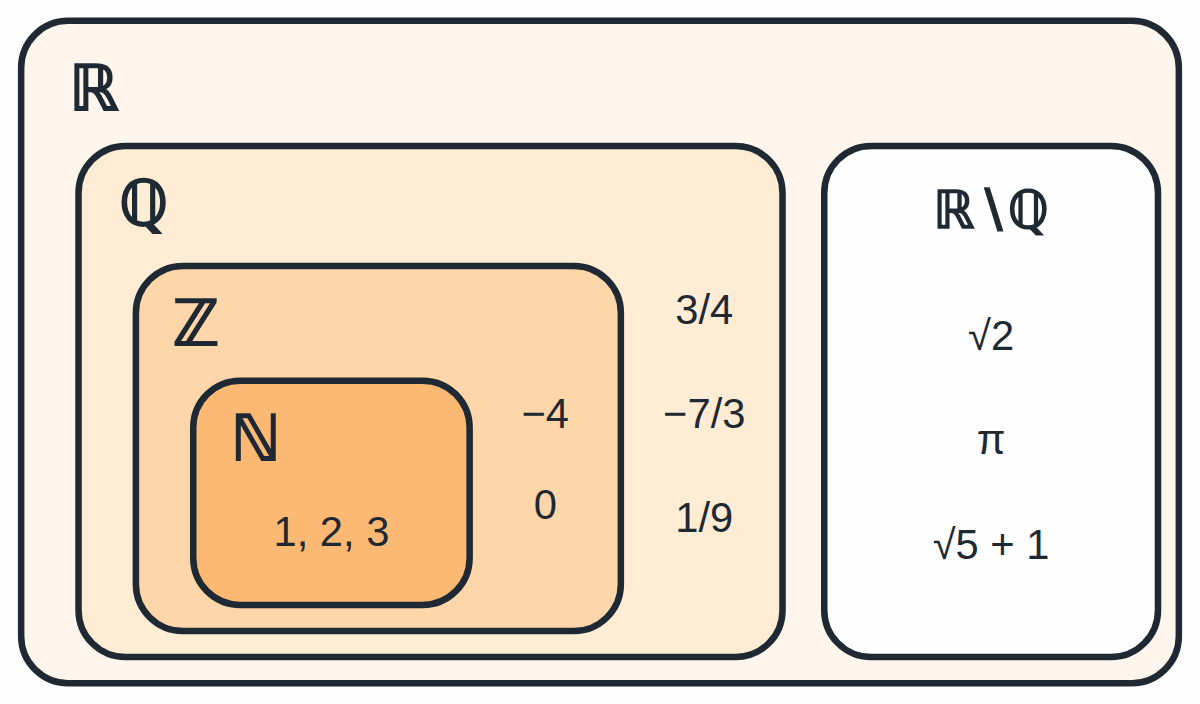
- Every natural number is an integer: ℕ ⊆ ℤ.
- Every integer is rational (5 = 5/1): ℤ ⊆ ℚ.
- Every rational number is real: ℚ ⊆ ℝ.
- Irrational numbers are real as well, but they have nothing in common with the rational ones. Every real number is either rational or irrational — never both.
We write: ℕ ⊆ ℤ ⊆ ℚ ⊆ ℝ. (The symbol ⊆ means “is a subset of” — see the next article.)
How to decide where a number belongs
Always go in the same order:
- Simplify the number if you can: √16 = 4, 12/4 = 3, (√3)² = 3.
- Can it be written as a fraction? If not → irrational: it belongs to ℝ ∖ ℚ and ℝ. Done.
- If yes, it is rational: it belongs to ℚ and ℝ.
- Is it a whole number? If yes, it also belongs to ℤ.
- Is it a positive whole number? If yes, it also belongs to ℕ.
Worked example 1
Which sets does −12/4 belong to?
- Simplify: −12/4 = −3.
- −3 can be written as a fraction (−3/1), so it is rational → ℚ, ℝ.
- −3 is a whole number → ℤ.
- −3 is not positive → not in ℕ.
- −12/4 ∈ ℤ, ℚ, ℝ.