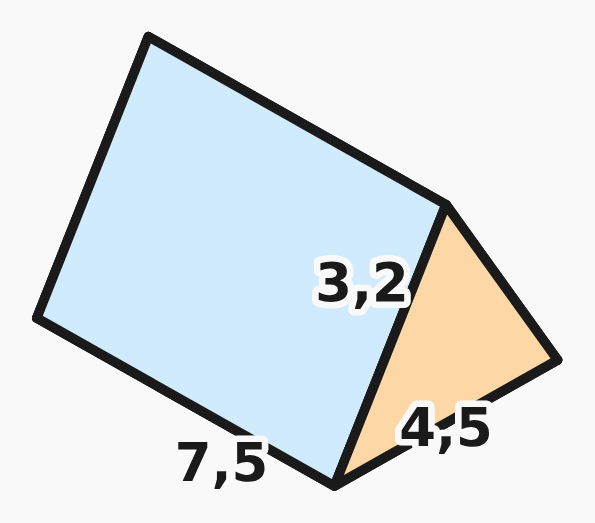
In grade 6 you learned to compute the surface area and volume of a cuboid and a cube with whole-number edges. In grade 7 two new layers come on top:
- Decimal edges — the same formula, with more careful arithmetic.
- Other types of prism — especially the triangular prism, whose base is not a rectangle.
1) Cuboid surface area with decimal edges
The formula stays the same:
S = 2 · (a·b + b·c + a·c)
Example: `a = 2.5 cm`, `b = 4 cm`, `c = 6 cm`.
| step | computation | result |
| a·b | `2.5 · 4` | `10 cm²` |
| b·c | `4 · 6` | `24 cm²` |
| a·c | `2.5 · 6` | `15 cm²` |
| sum | `10 + 24 + 15` | `49 cm²` |
| × 2 | `2 · 49` | 98 cm² |
- Multiply first whichever pair has only one decimal (e.g. `2.5 · 4`) — that's always easy.
- When multiplying two decimals (e.g. `2.5 · 1.5`), help yourself with fractions: `5/2 · 3/2 = 15/4 = 3.75`.
- Check the unit at the end — surface area is always in square units (cm², m²).
2) Volume of a triangular prism
For any prism the same general formula holds:
V = Sp · hp
where `S_p` is the base area and `h_p` is the prism height (distance between the two parallel bases).
For a triangular prism you first compute the area of the triangular base:
Sp = (a · h△) / 2
Example: base side `a = 6 cm`, triangle height `h_△ = 4 cm`, prism height `h_p = 10 cm`.
- Base area: `S_p = (6 · 4) / 2 = 12 cm²`.
- Volume: `V = 12 · 10 = 120 cm³`.
Don't mix up the two heights: `h_△` is the height of the triangle (perpendicular from a side to the opposite vertex), `h_p` is the height of the prism (distance between the two bases). They often have different values.
A common schema for volume
| prism type | base area | volume |
| cuboid (a × b) | `a · b` | `a · b · c` |
| cube (a) | `a²` | `a³` |
| triangular (a, h_△) | `(a · h_△) / 2` | `(a · h_△ · h_p) / 2` |
| other (S_p given) | `S_p` | `S_p · h_p` |