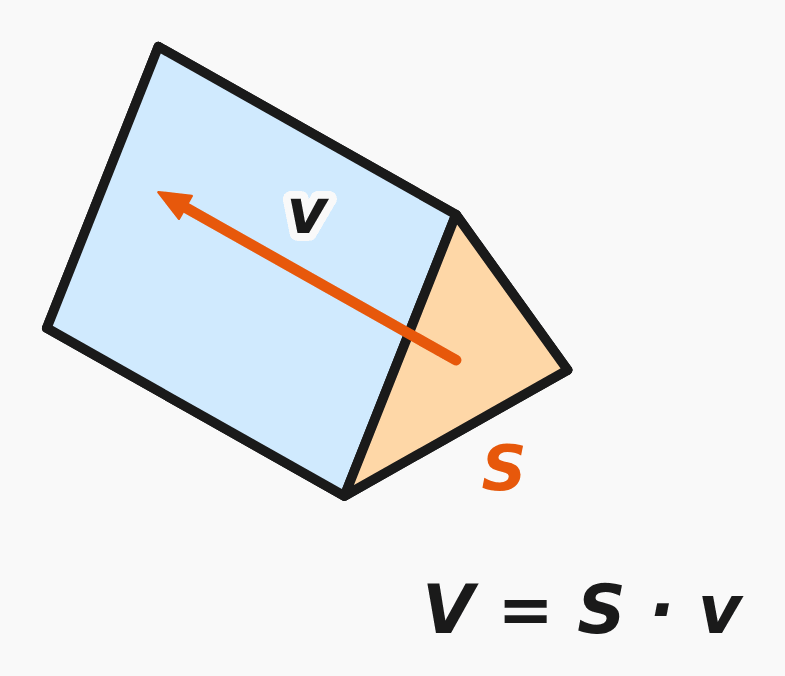
A prism is a solid whose two bases are congruent polygons and whose lateral faces are rectangles (when the prism is right). Its volume is given by a universal formula:
V = Sp · h
where `Sp` is the base area and `h` is the height of the prism (the perpendicular distance between the two bases).
Why it works
Picture a prism as a stack of "slices" of the same shape. Each slice has the same area `Sp`. If there are `h` of them stacked up, the total volume is `Sp · h`.
Example 1 — triangular prism
The triangular base has area 12 cm². The prism height is 8 cm.
V = 12 · 8 = 96 cm³.
Example 2 — cuboid as a special case
A cuboid is a prism with a rectangular base. If `a = 5`, `b = 4`, `c = 3` cm:
- Sp = `5 · 4 = 20 cm²` (area of the rectangular base)
- V = `20 · 3 = 60 cm³`
The same result as `a · b · c`. ✓
Example 3 — hexagonal prism
A regular hexagonal prism with base area 25 cm² and height 10 cm:
V = 25 · 10 = 250 cm³.
Step by step
- Find the base area Sp (it could be a triangle, a quadrilateral, a hexagon…).
- Multiply by the prism height `h`.
- The result is in cubic units.
Watch out
- The prism height is the perpendicular distance between the bases, not a slanted edge.
- For more complex bases (triangle, trapezium), first compute `Sp` and only then multiply.