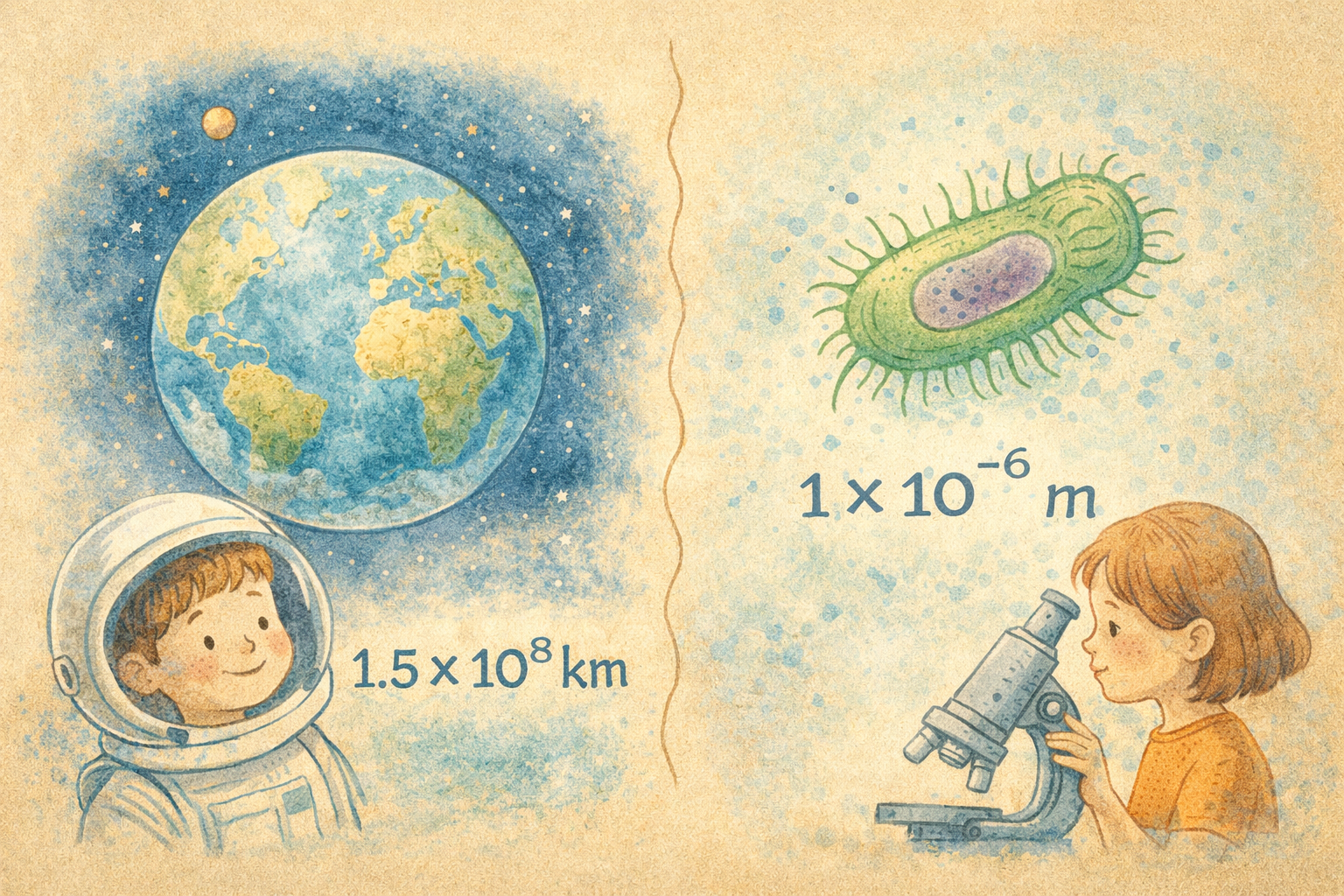
Science and technology use extremely large numbers (distance between planets, number of atoms) or extremely small numbers (size of atoms, electron mass). We use powers of 10 and scientific notation to write them simply.
Table of Contents
- What are powers of 10
- Positive powers of 10
- Negative powers of 10
- What is scientific notation (standard form)
- How to convert a number to scientific notation
- Examples from practice
- Where is this useful?
- Practice exercises
- Frequently Asked Questions
What are powers of 10
Powers of 10 are numbers obtained by raising 10 to various exponents. They form the basis of our decimal system and are used to simply write very large and very small numbers.Positive powers of 10
With a positive exponent, we move the decimal point to the right:
Overview of positive powers:- (one)
- (ten)
- (hundred)
- (thousand)
- (ten thousand)
- (hundred thousand)
- (million)
- (billion)
- (million)
💡 Tip: Each exponent tells you how many zeros are after the one. → 4 zeros.
Negative powers of 10
With a negative exponent, we move the decimal point to the left:
Overview of negative powers:- (tenth)
- (hundredth)
- (thousandth)
- (millionth)
👉 More about negative exponents: Negative exponents – explanation
What is scientific notation (standard form)
Scientific notation (or standard form) is a way to write large and small numbers simply and clearly.Definition
We write a number in the form:
where:
- is a number from 1 to 10 (including decimals)
- is an integer (positive or negative)
When do we use scientific notation?
- Large numbers: distance from Earth to the Sun is km
- Small numbers: diameter of an atom is approximately m
💡 Why the number from 1 to 10? So the number is "standardized" – it has only one digit before the decimal point. This is an international standard.
How to convert a number to scientific notation
Step 1: Move the decimal point
Move the decimal point so that you get a number between 1 and 10.
Step 2: Count the moves
Count how many places you moved the decimal point. This becomes the exponent.
- If you moved right → exponent is negative
- If you moved left → exponent is positive
Examples
Example 1: 3,500,000- Step 1: Move decimal:
- Step 2: We moved 6 places left
- Step 3: Result:
- Step 1: Move decimal:
- Step 2: We moved 5 places right
- Step 3: Result:
More examples
Examples from practice
Astronomy
- Distance from Earth to the Moon: m
- Distance from Earth to the Sun: m
- Number of stars in the Milky Way: approximately
Physics
- Speed of light: m/s
- Planck's constant: J·s
- Electron mass: kg
Chemistry
- Avogadro's number: mol
- One atomic mass unit: kg
Biology
- Size of a cell: approximately m
- Size of a virus: approximately m
- Number of bacteria on Earth: approximately
Where is this useful?
Making large numbers manageable
Instead of writing 156,000,000,000,000, we write .
Making calculations easier
Multiplying large numbers:
Dividing large numbers:
Practice exercises
Interactive exercises
- 🔢 Basic powers
- 📊 Scientific notation – practice moving the decimal point
- 🧮 Calculating with powers
- ✏️ Simplifying expressions
Practice problems
Convert to scientific notation:- 45,000
- 0.000 67
- 1,230,000
Frequently Asked Questions
Why do scientists use scientific notation?
Because atoms, stars, and molecules are either extremely large (billions of billions) or extremely small (billionths of a millimeter). Scientific notation makes these numbers readable and easier to work with.
Can the exponent be zero?
Yes! , so .
What's the difference between and ?
These are completely different values!
How do I multiply numbers in scientific notation?
Multiply the coefficients and add the exponents:
How do I divide numbers in scientific notation?
Divide the coefficients and subtract the exponents:
Summary
SI Prefixes:- Kilo- (): 1,000
- Mega- (): 1,000,000
- Giga- (): 1,000,000,000
- Tera- (): 1,000,000,000,000
- Milli- (): 0.001
- Micro- (): 0.000001
- Nano- (): 0.000000001
- Pico- (): 0.000000000001