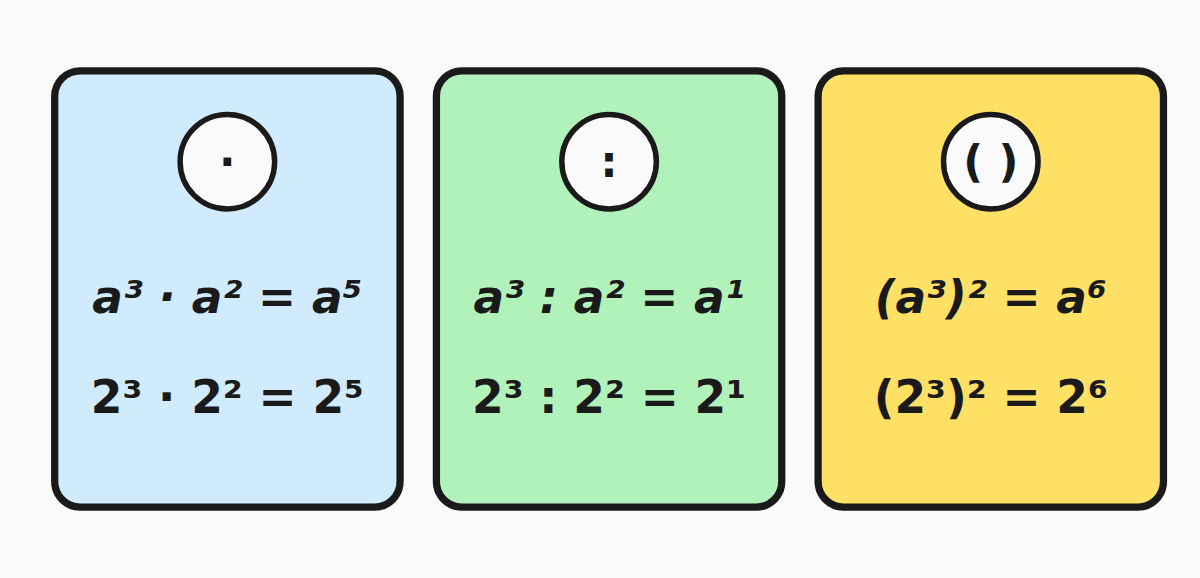
Mathematics in 9th grade requires mastering the fundamental formulas for powers. Once you understand them, simplifying expressions will be a breeze. In this article, you'll find an overview of all rules with explanations and examples.
Table of Contents
- What is a power
- Rules of powers – overview
- 1. Multiplying powers with the same base
- 2. Dividing powers with the same base
- 3. Raising a power to a power
- 4. Multiplying powers with different bases
- 5. Raising a product to a power
- Common mistakes when calculating with powers
- Quick reference of all rules
- Ready for the test?
- Frequently Asked Questions (FAQ)
What is a power
A power is a shorthand notation for repeated multiplication of the same number.
In this notation:
- is the base of the power – the number being multiplied
- is the exponent – how many times we multiply
💡 The base is what we multiply, the exponent tells us how many times.
Rules of powers overview
When working with powers, several important rules apply. These rules will make your calculations easier and help simplify expressions:
- Multiplication: (same base)
- Division: (same base)
- Raising to a power: (always)
- Product raised to a power: (always)
👉 For a basic introduction to powers, see: Powers – complete guide
1. Multiplying powers with the same base
When multiplying powers with the same base, keep the base and add the exponents.
Why does this work?
Examples
Exercise
👉 Examples on multiplying powers
2. Dividing powers with the same base
When dividing powers with the same base, keep the base and subtract the exponents.
Examples
Watch out for negative exponents!
The resulting exponent can also be negative. In that case, you get a fraction:
👉 What does a negative exponent mean? Negative exponents – explanation
3. Raising a power to a power
When raising an existing power to another power, multiply the exponents.
Why does this work?
Examples
⚠️ Common mistake: ! The exponents are multiplied (), not added!
4. Multiplying powers with different bases
What if the powers have different bases? In this case, you must first calculate each power individually:
Example:
5. Raising a product to a power
When raising a product (expression in parentheses) to a power, we raise each factor to that power:
Examples
Common mistakes when calculating with powers
Mistake 1: Adding exponents with different bases
You can only add exponents if the base is the same!
Mistake 2: Multiplying instead of adding exponents
Mistake 3: Adding exponents when raising to a power
Mistake 4: Confusing the signs
Remember:
- (positive, because we square -2)
- (negative, because we square 2 and then apply the minus)
Quick reference of all rules
Quick reference:- Multiplication (same base): → Example:
- Division (same base): → Example:
- Power of a power: → Example:
- Product to a power: → Example:
- Same exponent, different bases: → Example:
Ready for the test
Test yourself with our interactive exercises:
Interactive exercises
- 🔢 Basic powers
- 🧮 Calculating with powers
- ✏️ Simplifying expressions
- 🔤 Powers with letters
- ➗ Powers with fractions
Frequently Asked Questions (FAQ)
Can I add ?
No. Adding powers is only possible if they are exactly the same term. cannot be simplified because the exponents are different.What is the difference between and ?
- – we're multiplying two different powers with the same base. We add the exponents:
- – we're raising a power to another power. We multiply the exponents:
Why does ?
From the division rule: . But we also know that any number divided by itself equals 1. Therefore .
When do I get a negative exponent?
When dividing powers where the divisor's exponent is larger: