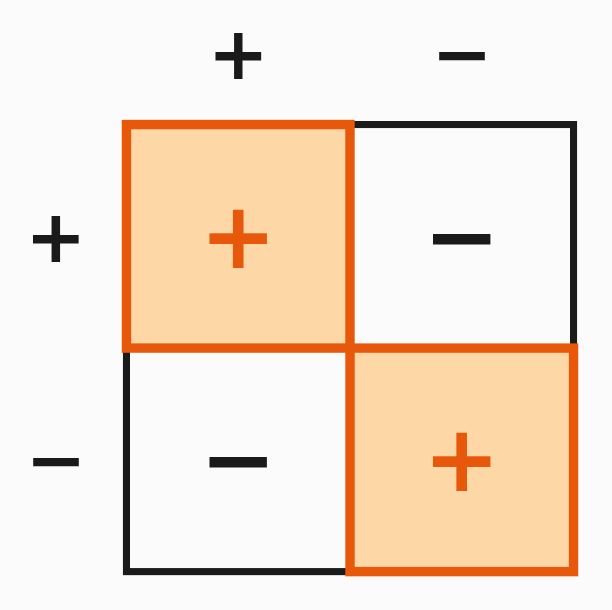
For multiplication and division, the rules are even simpler than for addition and subtraction. There are only two rules — and you can learn them in a minute.
The sign rule
Same signs → result is positive.
Different signs → result is negative.
This holds identically for both multiplication and division. Addition and subtraction behave differently (see Add and subtract).
| expression | signs | result |
| `(+3) × (+4)` | + and + | +12 |
| `(+3) × (−4)` | + and − | −12 |
| `(−3) × (+4)` | − and + | −12 |
| `(−3) × (−4)` | − and − | +12 |
| `(−12) ÷ (+3)` | − and + | −4 |
| `(−12) ÷ (−4)` | − and − | +3 |
Short form:
| rule | example |
| `(+) × (+) = +` | `4 × 5 = 20` |
| `(−) × (−) = +` | `(−4) × (−5) = 20` |
| `(+) × (−) = −` | `4 × (−5) = −20` |
| `(−) × (+) = −` | `(−4) × 5 = −20` |
How to think about it
The simplest trick: set the signs aside, multiply the magnitudes, then add the sign back according to the rule.
Example: `(−6) × 4`.
- Magnitudes: `6 × 4 = 24`.
- Signs: − and + → different → result negative.
- Result: −24.
Why does `(−) × (−) = (+)`?
Remember: multiplying by a negative is "the opposite". If you take "the opposite of the opposite", you are back to where you started — the result is positive.
Intuition: `(−1) × (−1) = +1` says "opposite of opposite = original direction".