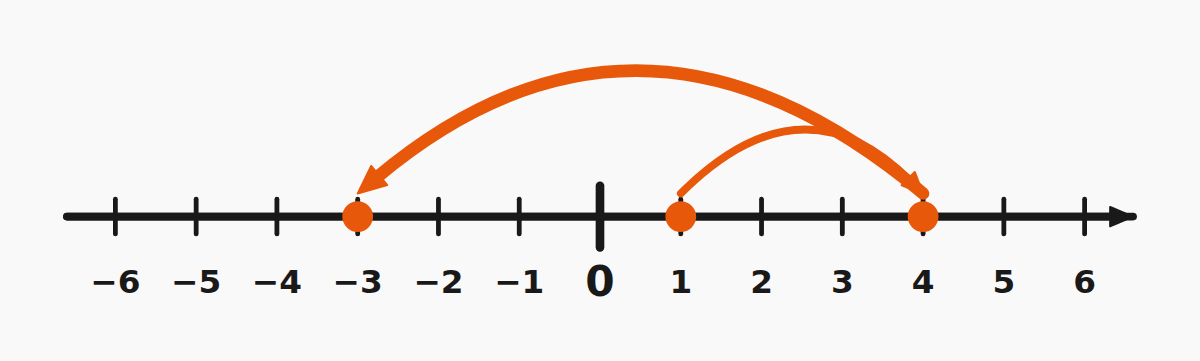
Adding and subtracting negative numbers is really the same idea — you just need to remember two sign rules.
Rule 1 — subtraction turned into addition
`a − b = a + (−b)`
Subtracting `b` means adding its opposite. That converts everything into addition.
Likewise:
`a − (−b) = a + b`
Two minus signs in a row "cancel" — the result is plus.
Rule 2 — adding with same or different signs
Same signs (both positive or both negative):- add the absolute values;
- keep the sign.
Different signs (one positive, one negative):`(−3) + (−4) = −(3 + 4) = −7`
- subtract the absolute values (larger − smaller);
- the sign is the same as the number with the larger absolute value.
`(−7) + 3 = −(7 − 3) = −4` (|−7| > |3|, so the result is negative)
`7 + (−3) = +(7 − 3) = 4` (|7| > |−3|, so the result is positive)
Picture on the number line
You can think of adding and subtracting integers as steps on the number line:
- `+5` means 5 steps to the right.
- `−5` means 5 steps to the left.
- `a − b` is the same as `a + (−b)`, so subtracting is "steps in the opposite direction".
Common mistakes
- `−3 − 5 ≠ 2`. Correct: `−3 − 5 = −3 + (−5) = −8` (both pull left).
- `7 − (−3) ≠ 4`. Correct: `7 − (−3) = 7 + 3 = 10`.
- `(−2) + (−3) ≠ −1`. Correct: both are negative → `−(2 + 3) = −5`.