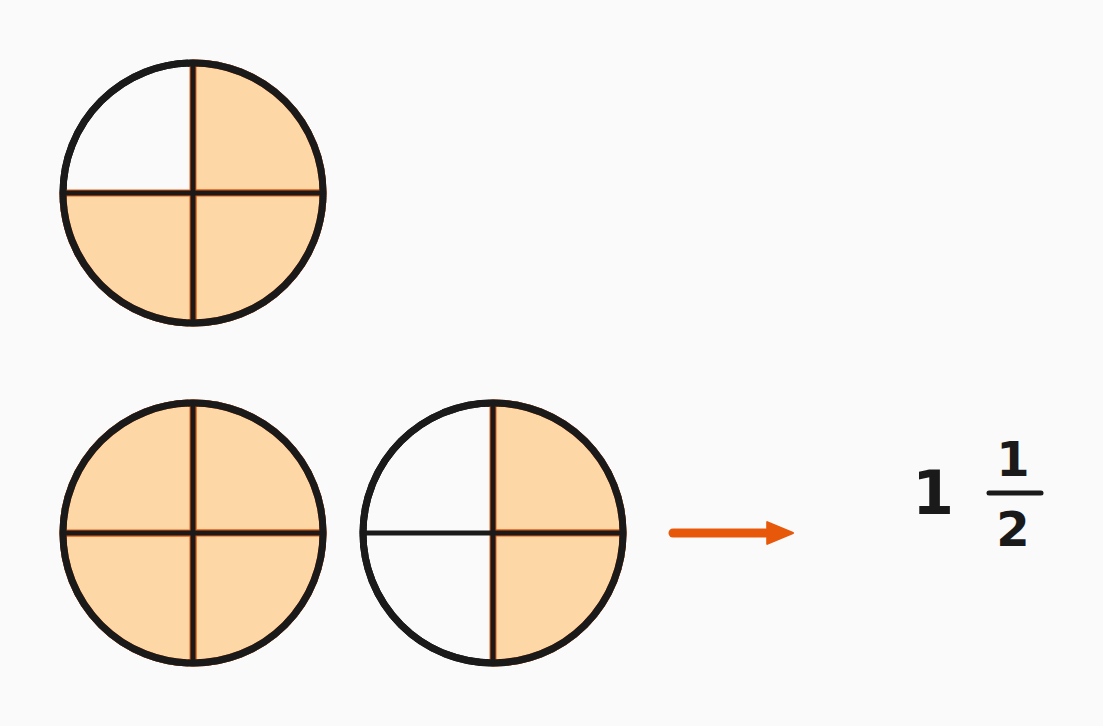
Every fraction has two numbers: the numerator on top (how many parts we take) and the denominator on the bottom (how many equal parts the whole is split into). Depending on which one is bigger, a fraction is either proper or improper.
Proper fraction
A proper fraction has a numerator smaller than its denominator, so its value is less than one whole.
- 3/4 — you took 3 of the 4 slices, less than a whole pizza.
- 2/5, 1/2, 5/6 — all smaller than 1.
If the top number is smaller than the bottom number, the fraction is proper and is less than one whole.
Improper fraction
An improper fraction has a numerator greater than or equal to its denominator, so its value is one whole or more.
- 7/4 — you have 7 quarters. 4 quarters make 1 whole, so 7/4 is more than a whole.
- 5/5 — exactly 1 whole.
- 9/2, 6/6, 11/3 — all equal to 1 or greater.
If the top number is greater than or equal to the bottom number, the fraction is improper and stands for at least one whole.
Mixed number
An improper fraction can also be written as a mixed number — a whole part followed by a proper fraction. It is the same value, just a different way to write it.
7/4 = 1 and 3/4 (one whole and three quarters)
Picture 7 quarter-slices of a cake: 4 quarters make 1 whole cake and 3 quarters are left over. So 7/4 = 1 3/4.
From an improper fraction to a mixed number
Divide the numerator by the denominator with a remainder:- Work out how many times the denominator fits into the numerator — that is the whole part.
- The remainder becomes the new numerator; the denominator stays the same.
Example: 11/3.
- 11 ÷ 3 = 3, remainder 2.
- The whole part is 3, and the remainder 2 gives the fraction 2/3.
- Result: 11/3 = 3 2/3.
From a mixed number to an improper fraction
The steps run the other way:
- Multiply the whole number by the denominator.
- Add the numerator — this is the new numerator.
- The denominator stays the same.
Example: 2 3/5.
- 2 · 5 = 10.
- 10 + 3 = 13.
- Result: 2 3/5 = 13/5.
Check
Converting one way and back must give the original number. From 13/5 back: 13 ÷ 5 = 2, remainder 3 → 2 3/5. ✓
Common traps
- Mixing up proper and improper. Only one thing matters: is the numerator smaller or larger than the denominator?
- Changing the denominator when converting. It does not change — only the numerator becomes the remainder.
- Dropping the remainder. When you divide with a remainder, never leave it out.