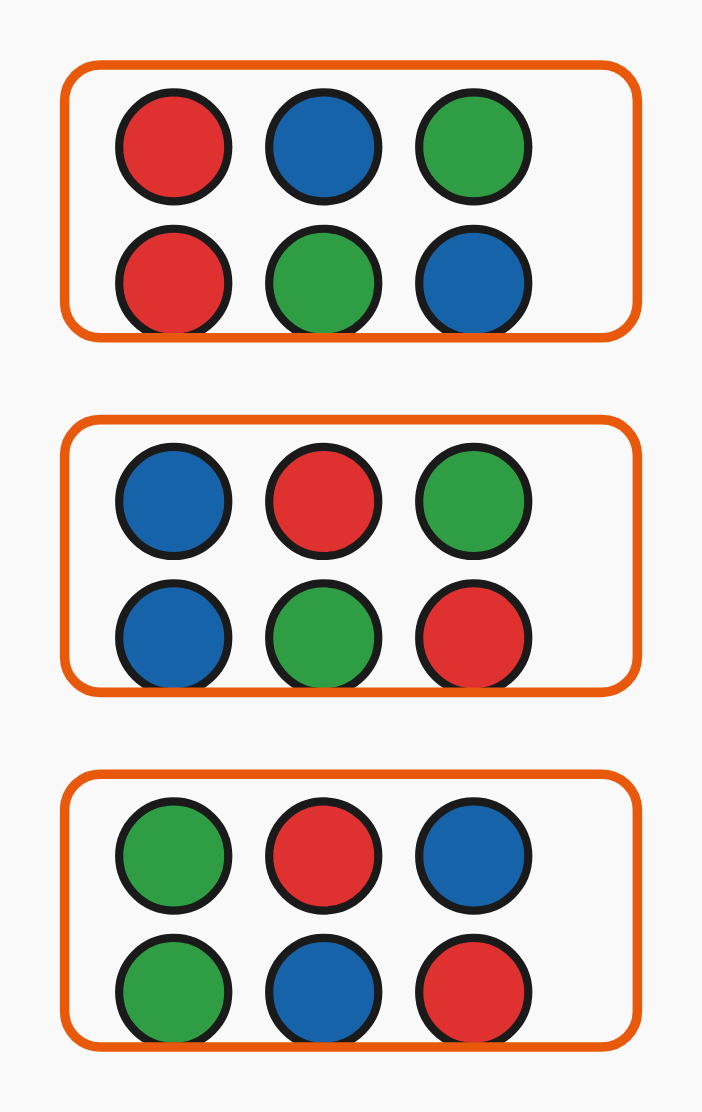
An arrangement is a choice of items in which order matters. The triple 1-2-3 is a different arrangement from 3-2-1, even though it uses the same digits.
Three items, three positions
Take the set {A, B, C}. We want all triples in which the items do not repeat. Work position by position:
- For the first position there are 3 choices (A, B or C).
- After fixing the first item, only 2 choices remain for the second.
- Only 1 choice remains for the third.
Together 3 · 2 · 1 = 6 arrangements:
| 1st position | 2nd position | 3rd position |
| A | B | C |
| A | C | B |
| B | A | C |
| B | C | A |
| C | A | B |
| C | B | A |
Four items, choose three
From the set {1, 2, 3, 4} we pick 3-element arrangements without repetition.
- For the first position there are 4 choices.
- For the second, 3 remain.
- For the third, 2 remain.
Together 4 · 3 · 2 = 24 arrangements.
If you doubt it, list them in groups of six: first all triples starting with 1 (123, 124, 132, 134, 142, 143), then those starting with 2, 3 and 4. Each group has exactly 6 triples — and 6 + 6 + 6 + 6 = 24.
Common mistakes
- Counting the size of the set and forgetting that the second position has one fewer choice. It is not 3 · 3 · 3 but 3 · 2 · 1.
- Confusing arrangements with pairs. For arrangements the order matters; for a pair it does not.
Tip for school problems
When there are many items and many positions, write out the first few starts and notice that each one produces the same number of continuations. That is exactly the multiplication rule — count by blocks.