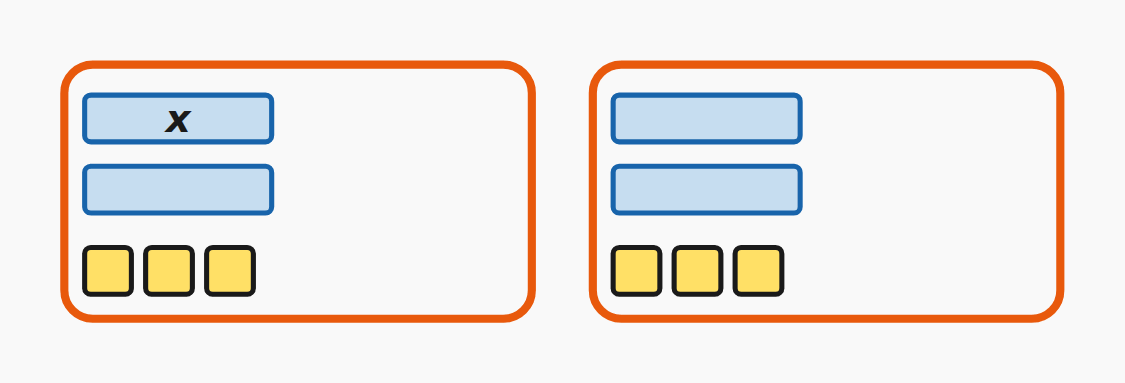
In grade 6 you started with a variable like `x` and solved simple one-step
equations. In grade 7 we go further — we manipulate expressions even
when there is no equation to solve. Five tools you will use again and again:
- Combining like terms. `3a + 5 − a + 2` → `2a + 7`.
- Distributive property (expanding). `3·(2x − 4)` → `6x − 12`.
- Factoring a common factor. `6x + 9` → `3·(2x + 3)`.
- Substitution. Evaluate `a² + 2b` for `a = 3`, `b = 5` → `9 + 10 = 19`.
- Power laws (same base). `a^3 · a^2 = a^5`; `(a^2)^3 = a^6`; `a^5 ÷ a^2 = a^3`.
Why bother?
An expression is a piece of mathematics that stands for some number — but
the number depends on the variable. By rewriting the expression in a
simpler or factored form, you understand its structure better, andlater you can solve harder equations by recognising patterns.
Example: `3(x − 2) + 5x = 8x − 6`. Inside the expression there is
structure (a "scale by 3" plus another "scale by 5"). Simplifying makes
it visible.
A worked tour
Combining like terms
The variable `a` is a placeholder. Terms with the same variable
combine like ordinary numbers; constants combine separately.3a + 5 − a + 2
= (3a − a) + (5 + 2)
= 2a + 7Distributive property
The pattern `a · (b + c) = a·b + a·c` lets you eliminate parentheses.
3(2x − 4) = 3·2x + 3·(−4) = 6x − 12Read backwards, it lets you factor:
6x + 9 = 3·(2x + 3)Power laws
For the same base `a`:
| operation | rule |
| product | `a^m · a^n = a^(m+n)` |
| quotient | `a^m ÷ a^n = a^(m−n)` (m ≥ n) |
| power of power | `(a^m)^n = a^(m·n)` |