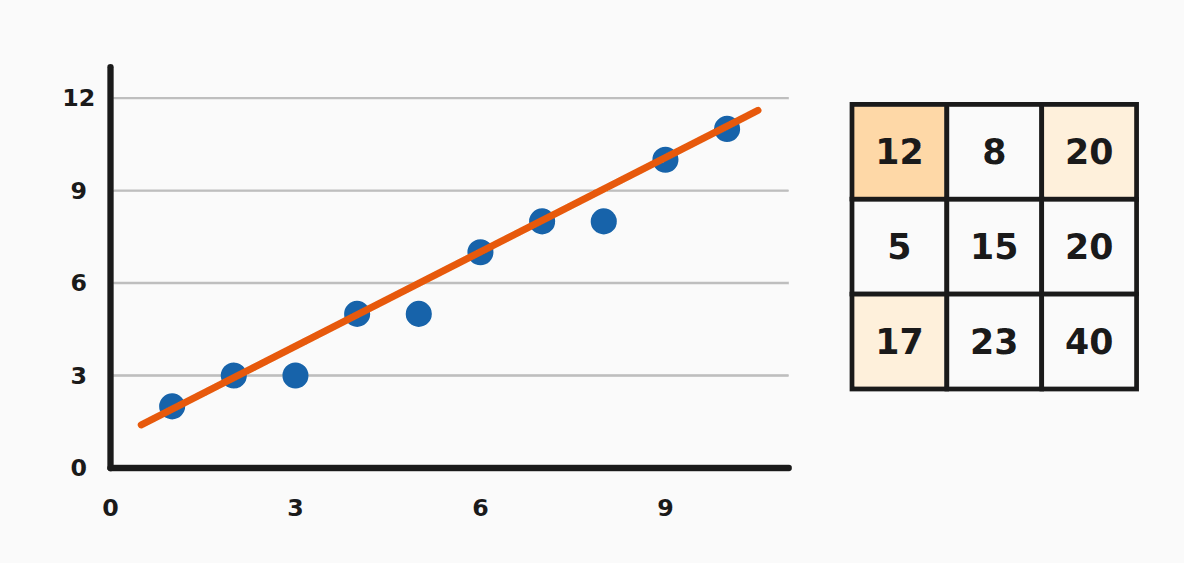
When we collect two measurements from each person or thing — like height and shoe size — we have bivariate data. Two tools help us see how the measurements are related: the scatter plot and the two-way table.
Scatter plots and association
A scatter plot draws one dot for each pair of values. The overall shape of the cloud of dots tells us about the association between the two quantities:
Positive association — as one quantity goes up, the other tends to go up too. The dots rise from left to right.
Negative association — as one quantity goes up, the other tends to go down. The dots fall from left to right.
No association — the dots are scattered with no clear up-or-down direction.
The stronger the pattern (the closer the dots are to a straight line), the stronger the association.
Line of best fit
When there is a clear linear pattern, we can draw a straight line of best fit that passes as close as possible to the dots. It lets us describe the trend and make rough predictions — but a single point off the line (an outlier) does not break the overall pattern.
Two-way tables
A two-way table (or two-way frequency table) sorts the same group of people by two categories at once — for example boys/girls across yes/no. The numbers inside are counts; the extra row and column hold the totals.
Because every row and every column must add up to its total, you can always find a missing value: subtract the value you can see from the total of its row or its column.
Three rules that always help
Read the direction of a scatter to name the association: rising = positive, falling = negative, no direction = none.
A line of best fit follows the trend; it does not need to touch every point.
In a two-way table each row and column adds to its total — use that to fill any gap.