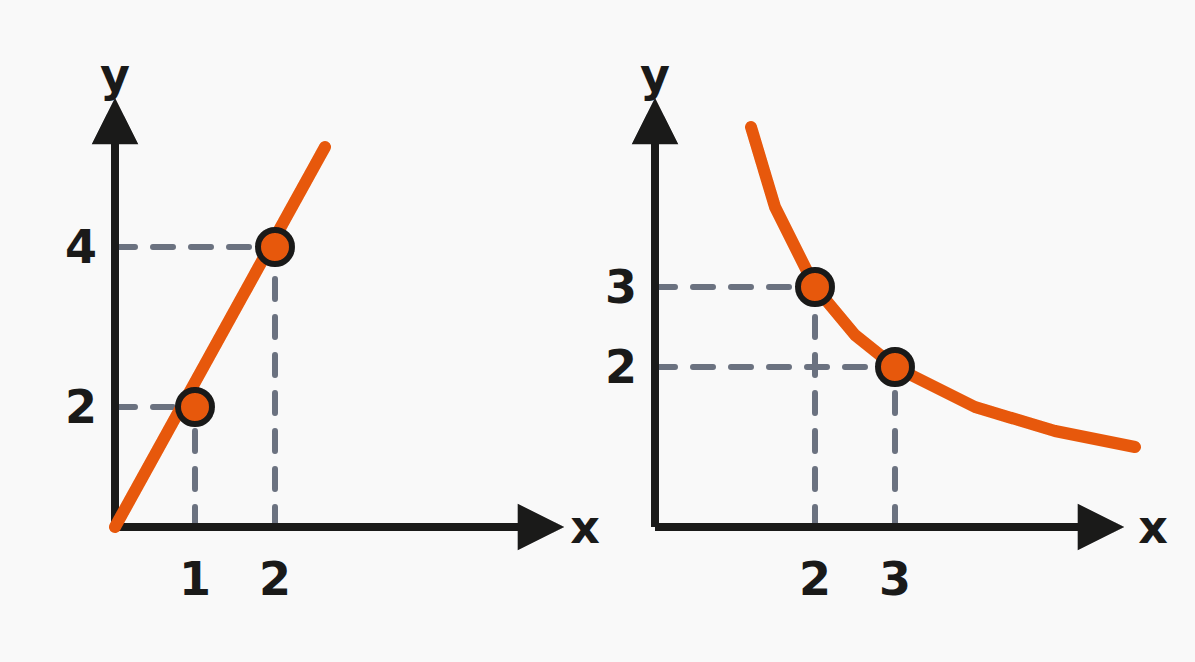
In grade 6 we met direct proportion — if one quantity grows, the other grows in the same ratio. In grade 7 a twin joins the family: inverse proportion. When one quantity grows, the other one shrinks so their product stays the same.
Direct proportion — a refresher
A recipe for 4 people needs 200 g of flour. For 8 people (twice as many) you need 400 g of flour (twice as much). The ratio people : flour is unchanged.
If one quantity grows N times, the other one also grows N times.
Rule of three for a direct proportion:
| people | flour |
| 4 | 200 g |
| 10 | ? |
Method: find how much for 1 person → `200 ÷ 4 = 50 g`. Then multiply → `50 × 10 = 500 g`.
Inverse proportion — a new view
If 6 workers can dig a hole in 4 hours, how many hours will it take 8 workers?
Here you cannot say "more workers, more hours." The opposite — the more hands helping, the shorter the time. This is inverse proportion.
If one quantity grows N times, the other one shrinks N times. The product of the two quantities stays the same.
Rule of three for an inverse proportion — solved differently:
| workers | hours |
| 6 | 4 |
| 8 | ? |
Method: multiply the top row → `6 × 4 = 24`. That is the constant product (24 worker-hours of total work). Then divide by the known number in the bottom row → `24 ÷ 8 = 3 hours`.
How do you tell which kind it is?
Ask: "If I put in more, do I get more or less?"
- More → more: direct proportion (recipe, scale on a map, price per unit).
- More → less: inverse proportion (workers and time, speed and travel time, sharing into equal portions).
Formulas at a glance
| type | relation | rule of three |
| direct proportion | `a/b = c/x` | `x = (b · c) / a` |
| inverse proportion | `a · b = c · x` | `x = (a · b) / c` |
Notice — for an inverse proportion you always multiply first (top row → constant product) and divide second. For a direct proportion it is the other way around — divide first (find per-unit value), then multiply.