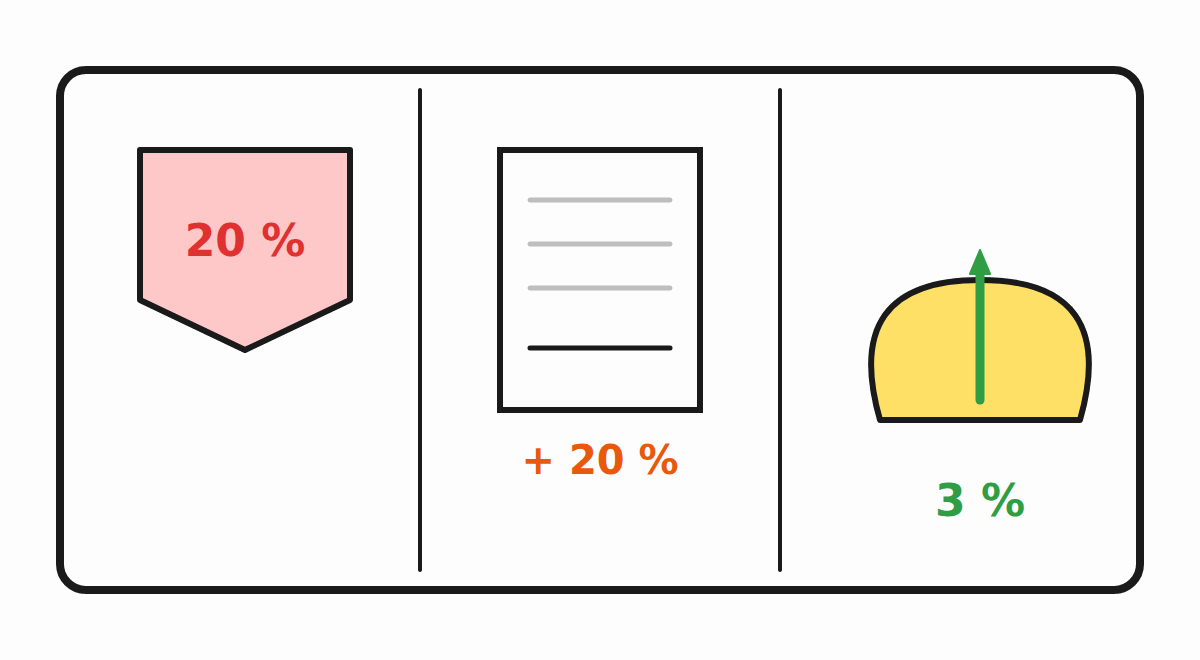
You see percents every day — in shops, restaurants, at the bank. Let us see how each situation is computed.
Discount
A jacket costs $80 with a 25 % discount. First compute the discount, then subtract it.- Discount: `80 × 25 ÷ 100 = 20`
- Final price: `80 − 20 = 60`
Tax
Pre-tax price is $50, tax is 20 %. Add the tax.- Tax: `50 × 20 ÷ 100 = 10`
- Final price: `50 + 10 = 60`
Tip
Bill of $30, 15 % tip.- Tip: `30 × 15 ÷ 100 = 4.50`
- Total: `30 + 4.50 = 34.50`
Simple interest
You deposit $500 at the bank at 4 % per year. How much interest will you earn in 3 years?Formula: `interest = principal × rate × time ÷ 100`
- `500 × 4 × 3 ÷ 100 = 60`
After 3 years you will have `500 + 60 = 560`.
Note — simple vs compound interest. In simple interest the interest is always computed on the original principal, never on interest already paid. Compound interest (where interest itself earns more interest) is taught later.
A shared formula
All four scenarios use the same idea:
`percent part = whole × percent ÷ 100`
The only difference is whether you add or subtract afterwards (subtract for a discount, add for tax, tip, and interest).