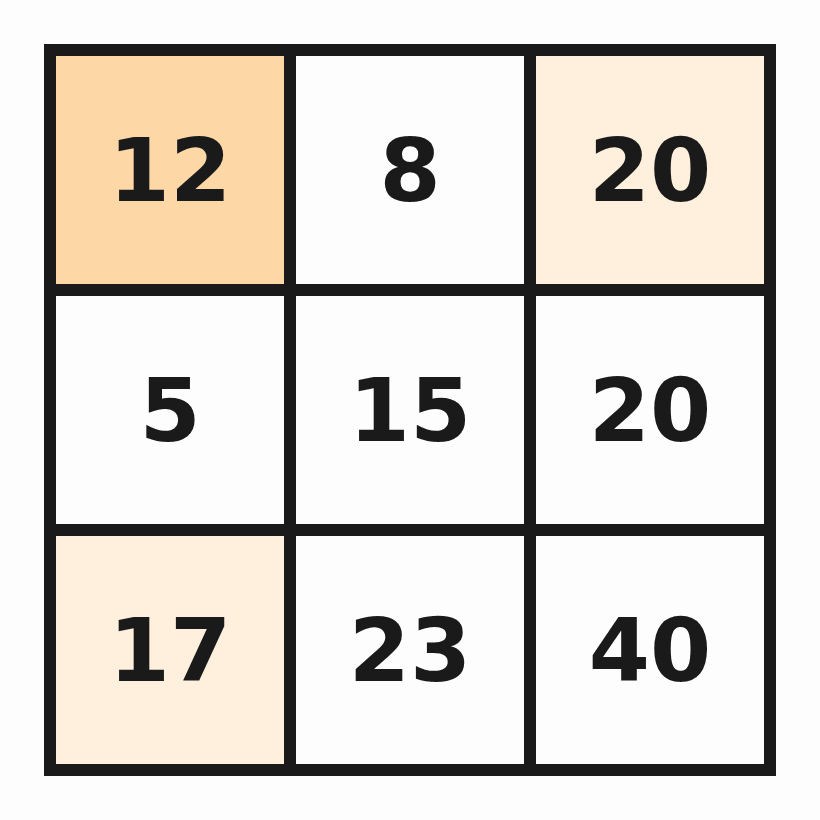
A two-way table sorts the same group of people by two categories at once — for example boys and girls across yes and no. The numbers inside are counts, and the extra row and column hold the totals.
Reading the table
Each inner cell answers a "both" question, like "how many girls answered no?". The totals tell you how many are in each row, each column, and the whole group.
Filling a missing value
Every row and every column must add up to its total. So if one inner number is missing, subtract the value you can see from the total of its row or its column.
For example, if a row total is 12 and one of its two cells is 5, the other cell is 12 − 5 = 7.
Three rules that always help
- Inner cells are counts for two categories at once.
- Each row and column adds up to its total.
- Find a missing cell by subtracting from the row or column total.
Keep going
- Practice: Two-way tables
- Back to the scatter plots overview