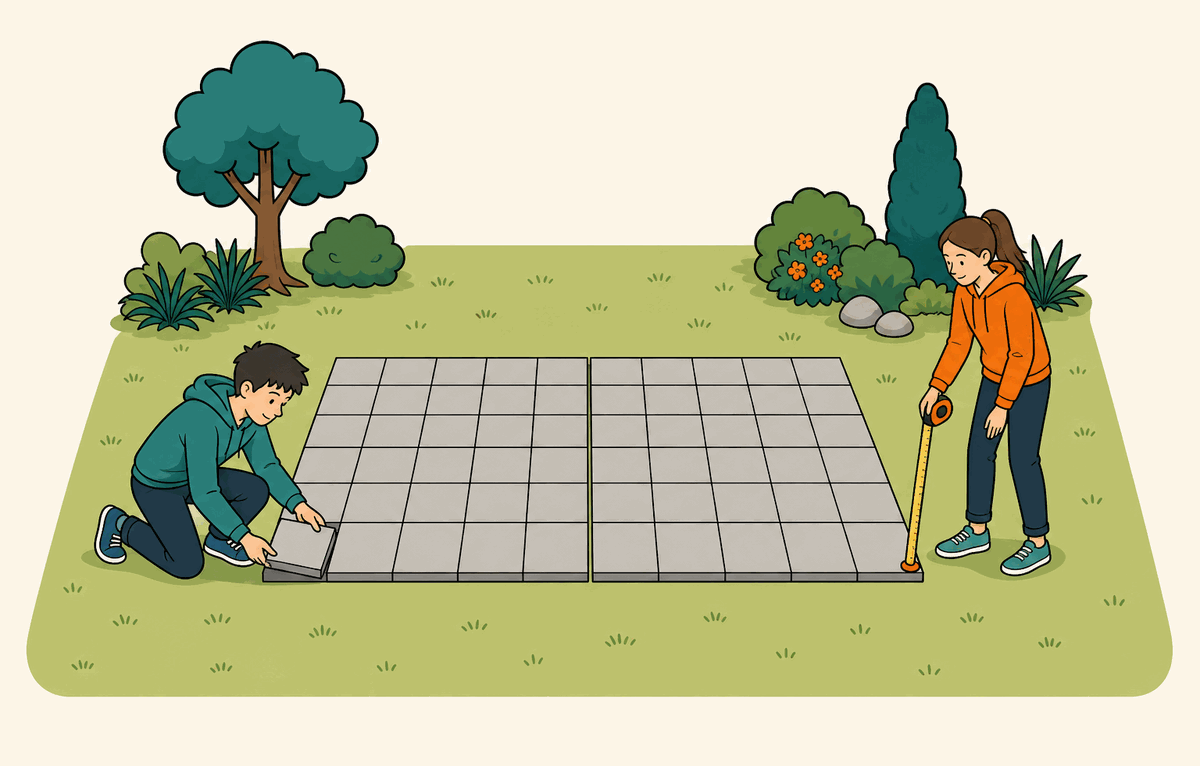
A square garden has an area of 72 m². How long is one side? We need a number that gives 72 when you square it, so we need √72. A calculator shows 8.4852…, a number whose decimals never end. The only way to write it exactly is with a root.
But √72 can be written more simply as 6√2. Both are the same number. The second form is just shorter and easier to work with. This is called simplifying a surd. A surd is a root that cannot be written as a whole number or a fraction. In the US, surds are usually called radicals, and the simplified form is called simplest radical form.
The square root of a number a (we read √a as "the square root of a") is the number that is not negative and gives a when you square it. For example, √36 = 6, because 6² = 36.
The cube root of a number a (we read ∛a as "the cube root of a") is the number that gives a when you cube it. For example, ∛8 = 2, because 2³ = 8.
The number under the root sign is the radicand. The small number at the top left of ∛ is the index of the root. It tells you which root it is. For a square root we do not write the 2.
It pays to know the squares and cubes of small numbers:
n
2
3
4
5
6
7
8
9
10
n²
4
9
16
25
36
49
64
81
100
n³
8
27
64
125
216
343
512
729
1000
The main idea
The root of a product equals the product of the roots:
√(a · b) = √a · √b (for a ≥ 0, b ≥ 0, read "a and b are not negative")
Let's check with an example: √(4 · 9) = √36 = 6 and √4 · √9 = 2 · 3 = 6. It works.
So if we split the radicand into a product where one factor is a square, we can take the square root of that factor and move it in front of the root.
Step by step
Worked example 1
√72
Find the largest square that divides 72. Try from the larger ones: 64 no, 49 no, 36 yes, so 72 = 36 · 2.
√72 = √(36 · 2) = √36 · √2.
√36 = 6, so √72 = 6√2.
We read 6√2 as "six root two". It means 6 · √2.
Worked example 2
√180
180 = 36 · 5.
√180 = √36 · √5 = 6√5.
How to find the largest square
If you cannot see it straight away, write the number as a product of primes and look for pairs: 180 = 2 · 2 · 3 · 3 · 5. From each pair, one number goes in front of the root: 2 · 3 = 6. Whatever has no partner stays under the root: 5. So √180 = 6√5.
💡 It is fine to take out a smaller square first: √72 = √(4 · 18) = 2√18. But 18 = 9 · 2 still contains a square, so you carry on: 2√18 = 2 · 3√2 = 6√2. You are only finished when no square other than 1 is left under the root.
A number in front of the root
If there is already a number in front of the root, multiply it by what you take out.
Worked example 3
3√50
50 = 25 · 2, so √50 = 5√2.
3√50 = 3 · 5√2 = 15√2.
Cube roots
With a cube root, look for a cube instead of a square: 8, 27, 64, 125…
∛(a · b) = ∛a · ∛b
Worked example 4
∛54
54 = 27 · 2 and 27 = 3³.
∛54 = ∛27 · ∛2 = 3∛2.
Worked example 5
∛250
250 = 125 · 2 and 125 = 5³.
∛250 = 5∛2.
⚠️ A square is not enough for a cube root. ∛72 = ∛(8 · 9) = 2∛9. The 9 stays under the cube root, because 9 is not a cube.
Surds with a variable
A variable works the same way. For a square root, look for even powers: a² = a · a, a⁴ = a² · a². We assume a ≥ 0 so that the expressions make sense (and the square root of a² really is a).
Worked example 6
√(18a³), a ≥ 0
The number: 18 = 9 · 2.
The variable: a³ = a² · a.
√(18a³) = √(9a² · 2a) = √(9a²) · √(2a) = 3a√(2a).
Worked example 7
∛(16b⁵)
16 = 8 · 2, b⁵ = b³ · b².
∛(16b⁵) = ∛(8b³) · ∛(2b²) = 2b∛(2b²).
Common mistakes
Stopping too early. √72 = 2√18 is correct, but it is not finished. 18 still contains the square 9.
Taking the root of a sum term by term. √(9 + 16) is not 3 + 4 = 7. The correct answer is √25 = 5. The rule √(a · b) = √a · √b works only for a product.
Leaving the factor you took out under the root. √(36 · 2) is 6√2, not 6√72 or 6√(36 · 2).
Looking for a square in a cube root. ∛18 cannot be simplified using 9. You need a cube.
Summary
√(a · b) = √a · √b and ∛(a · b) = ∛a · ∛b.
Split the radicand into a product with a square (a cube for ∛), take its root and write it in front of the root sign.
If there is already a number in front of the root, multiply it by what you take out.
You are finished when no square (cube) other than 1 is left under the root.