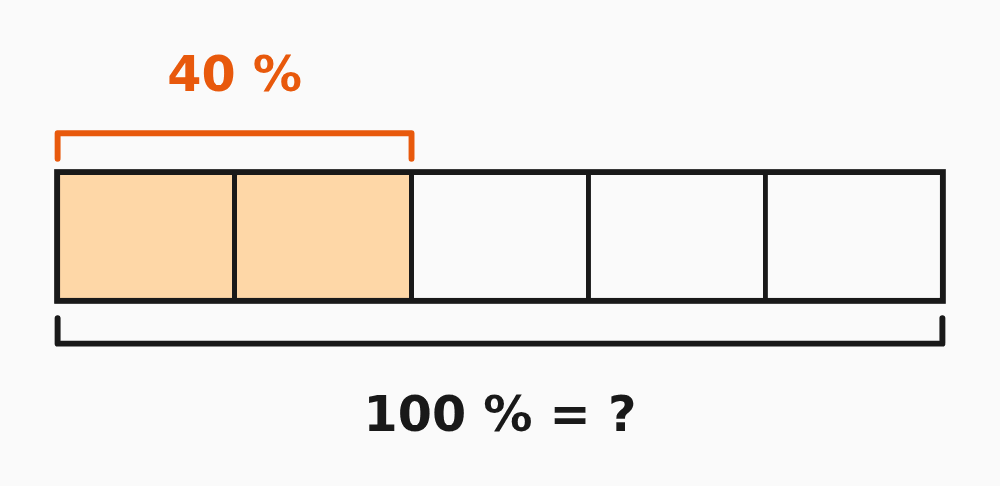
A common task with percentages is "take 25 % of 60". Sometimes the problem runs in the opposite direction: you know a part and a percent, and you have to find the whole. For example: "12 children are in the swimming club. That's 20 % of the whole year group. How many children are in the year group?"
Here is how to handle it.
The main idea
A percent tells you what fraction of the whole the part is. 20 % means 20/100, that is one-fifth. If 12 children are one-fifth of the whole, the whole must be five times as many.
In short:
Whole = (part × 100) ÷ percent.
For our example: whole = 12 × 100 ÷ 20 = 1200 ÷ 20 = 60 children.
Step by step
- Mark what you know: the part and the percent.
- Multiply the part by 100.
- Divide by the percent. The result is the whole.
- Check back: take the same percent of your answer; it should give back the part.
Example 1 — a quarter
6 boys are in a class, which is 25 % of the whole class. How many pupils does the class have?
- part = 6, percent = 25
- whole = 6 × 100 ÷ 25 = 600 ÷ 25 = 24 pupils
- check: 25 % of 24 = 24 ÷ 4 = 6 ✓
Example 2 — a tenth
4 children are in a club, which is 10 % of all the children in the school. How many children are in the school?
- part = 4, percent = 10
- whole = 4 × 100 ÷ 10 = 400 ÷ 10 = 40 children
Example 3 — three-quarters
60 children play at a hockey club, which is 75 % of all the children registered. How many registered?
- part = 60, percent = 75
- whole = 60 × 100 ÷ 75 = 6000 ÷ 75 = 80 children
Practical tips
- Find 1 % first for mental work. "20 % is 12 → 1 % is 12 ÷ 20 = 0.6 → 100 % is 60."
- Think in fractions — often faster. 25 % = ¼, so the whole = part × 4. 50 % = ½, so the whole = part × 2.
- Lower-bound sanity check. The whole must be at least as large as the part. If it comes out smaller, something is wrong.
Common mistakes
- Mixing up roles: multiplying the whole by the percent when you should be finding the whole (that's the opposite direction).
- Treating a percent like a plain number: 25 % is not 25; it's 25/100.
- Skipping the check. Always verify by going the other way.