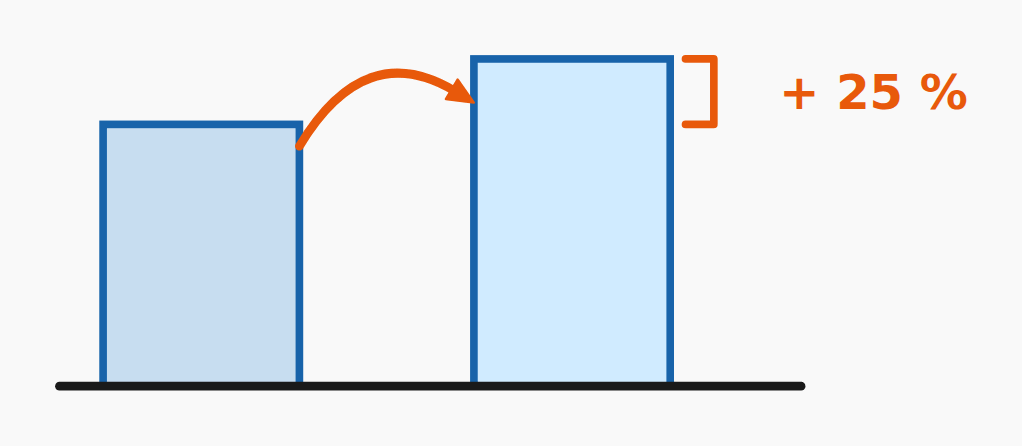
If a product cost 100, we say it went up by 25 %. But why exactly 25 %? Let us walk through it.
The formula
percent change = `(new − old) / old × 100 %`
If the result is positive, it is an increase. If negative, a decrease. In school problems we usually state the type in words and write only the absolute value.
Example 1 — increase
Bread used to cost 2.50.
- Difference: `2.50 − 2 = 0.50`
- Percent: `0.50 ÷ 2 × 100 = 25 %`
- The price went up by 25 %.
Example 2 — decrease (discount)
Shoes used to cost 45.
- Difference: `60 − 45 = 15`
- Percent: `15 ÷ 60 × 100 = 25 %`
- A 25 % discount.
Important — *what* you compute the percent of
Always divide by the old value, never by the new one.
This is a common mistake. If you divided 15 by 45 (the new price) in example 2, you would get an incorrect ~33 %.
Increase vs decrease in the opposite direction
Be careful — going the opposite way the percents are not the same:
- 100 → 80 = decrease of 20 % (divide by 100).
- 80 → 100 = increase of 25 % (divide by 80).
That is why a 50 % discount followed by a 50 % markup does not bring you back to the original price.