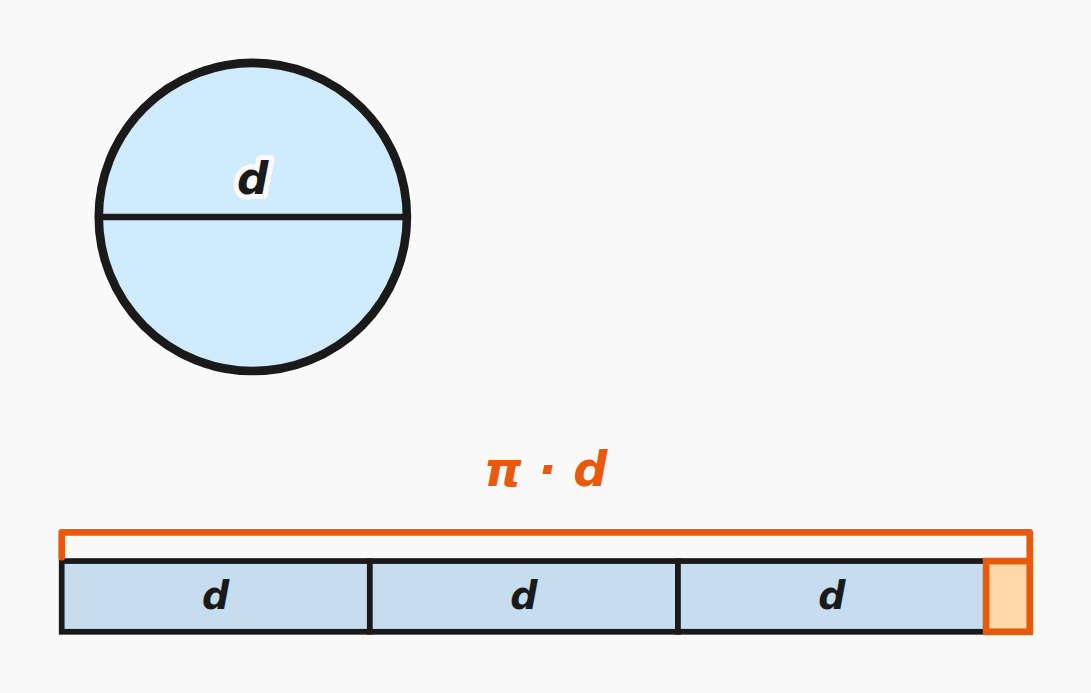
The circumference of a circle is the length around it — what you would measure if you wrapped a string once around a tin can and then stretched the string out next to a ruler. For thousands of years people have noticed something strange: when you divide the circumference by the diameter, you always get the same number, no matter how big or small the circle is.
That number is called π (pi). It is a little bigger than 3. In Grade 7 we round it to 3.14 and write π ≈ 3.14.
The formula
If a circle has radius r, then its diameter is 2 · r and its circumference is
O = 2 · π · r.
The 2 · r is the diameter — the distance straight across the circle through the centre — and π is the magic constant.
A small example
Take a CD with a radius of 6 cm. Its circumference is
O ≈ 2 · 3.14 · 6 = 37.7 cm.
If you put a string around the CD, the string would be about 37.7 cm long.
Why 3.14 is only an approximation
The true value of π begins 3.1415926535… and the decimals never repeat or stop. In Grade 7 we cannot use all those decimals, so we round to 3.14. Some older books prefer the fraction 22/7, which is also close. Both are accepted on this page — the difference is at most a couple of millimetres, which is fine for school exercises.
A common mistake
A frequent error is to write O = π · r² (that is the formula for area, not circumference) or to forget the factor 2. To avoid both, always think of the formula as: "twice the radius (the diameter), times π".