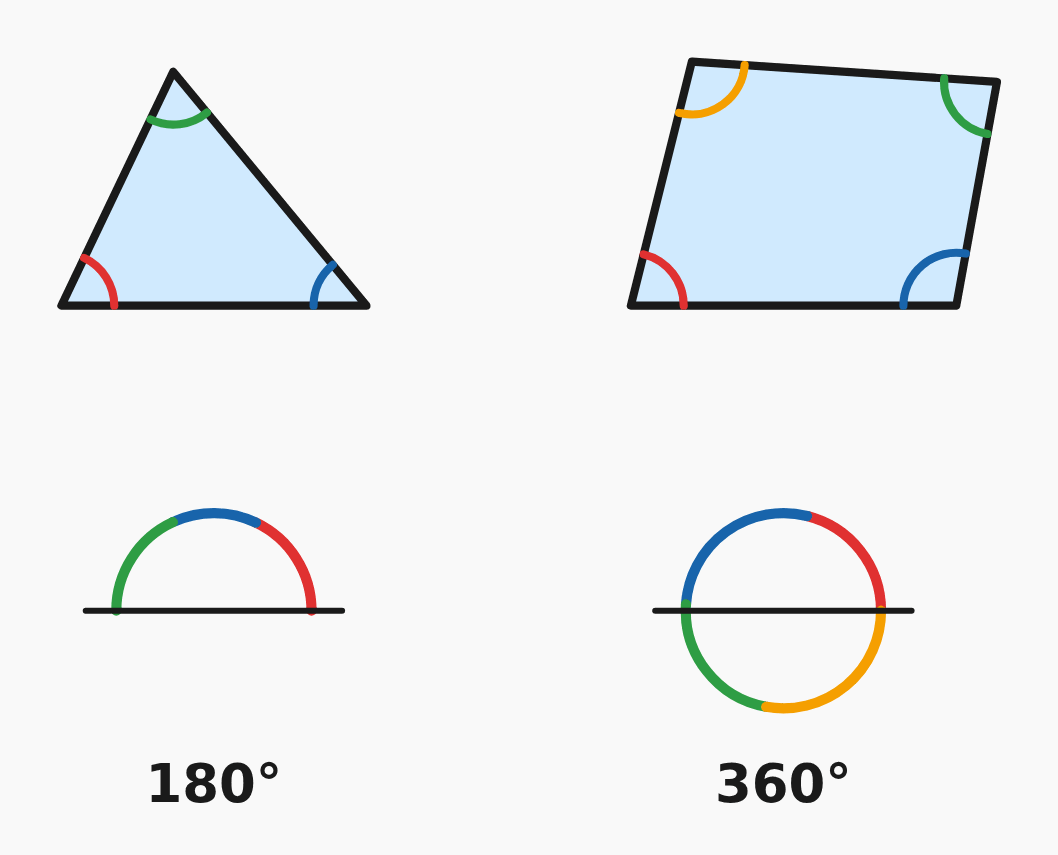
In Year 6 there are two facts that simplify a lot of geometry:
The interior angles of a triangle add up to 180°.
The interior angles of a quadrilateral add up to 360°.
These numbers aren't accidents — they follow from plane geometry.
Why a triangle sums to 180°
Take a triangle with angles α, β, γ. Through one vertex, draw a line parallel to the opposite side. Along that line you get three angles that together form a straight angle (180°). Those three angles are exactly α, β and γ — so
α + β + γ = 180°.
Using it — missing angle in a triangle
Example: two interior angles of a triangle are 70° and 60°. What's the third?
180° − 70° − 60° = 50°.
Why a quadrilateral sums to 360°
Any quadrilateral can be split by a diagonal into two triangles. Each one has a sum of 180°, so together 360°. Hence:
α + β + γ + δ = 360°.
Using it — missing angle in a quadrilateral
Example: three interior angles of a quadrilateral are 90°, 100° and 80°. What's the fourth?
360° − 90° − 100° − 80° = 90°.
Special cases
- Equilateral triangle: all three angles are 60°.
- Isosceles triangle: the two base angles are equal. If the apex angle is 80°, each base angle is (180 − 80) ÷ 2 = 50°.
- Right-angled triangle: one angle is 90°, so the other two add up to 90° (they are "complementary").
- Rectangle and square: all four angles are 90°. Together 360°.
Sanity check
Always verify with a quick sum. If three angles of a triangle come out to 60° + 70° + 60° = 190°, something is wrong — no triangle can have that sum.